
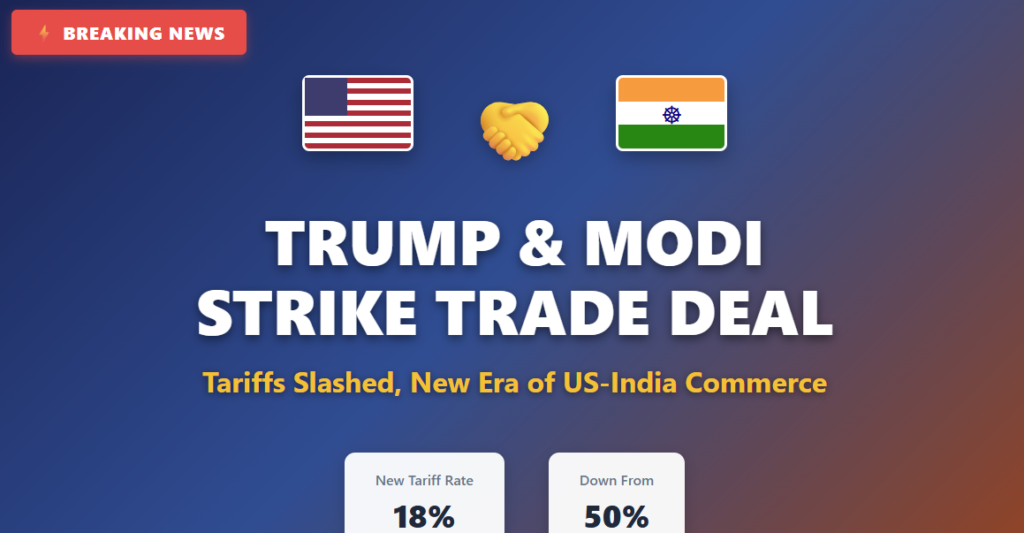
In a dramatic turn of events that underscores the volatile nature of modern trade diplomacy, U.S. President Donald Trump and Indian Prime Minister Narendra Modi announced a bilateral trade agreement on February 3, 2026, marking a significant thaw in what had become an increasingly strained relationship between the world’s oldest and largest democracies.
The deal, announced via Trump’s Truth Social platform, reduces tariffs on Indian goods from a punishing 50% to 18%. This represents a substantial relief for Indian exporters who had been reeling under what many economists called unsustainable trade barriers. The U.S. had previously imposed a 25% baseline tariff plus an additional 25% penalty specifically targeting India’s purchases of Russian oil, creating what appeared to be an insurmountable barrier to bilateral trade.
The Russian Oil Factor
At the heart of the agreement lies India’s commitment to halt purchases of Russian crude oil—a concession that could reshape global energy markets. India has been importing roughly 1.5 million barrels of Russian oil daily, accounting for more than a third of the country’s total oil imports. According to Trump’s announcement, Modi agreed to replace this with oil from the United States and potentially Venezuela, though experts remain skeptical about the timeline and feasibility of such a dramatic shift.
The promise addresses a key American concern: that Indian purchases were funding Russia’s war in Ukraine. Yet implementation faces significant hurdles. Russian oil has traded at substantial discounts compared to Western alternatives, making it economically attractive for energy-hungry India. Industry analysts suggest India may continue finding creative ways to access Russian crude through indirect channels.
Details Remain Murky
While both leaders celebrated the agreement, crucial details remain unclear or contested. Trump claimed India would buy $500 billion worth of American defense, transportation, energy, and farm goods, though this figure has been met with widespread skepticism. India’s total goods imports in the previous fiscal year stood at approximately $720 billion, making Trump’s target appear aspirational at best.
Significantly, Modi’s public statements have been notably selective. His social media posts expressed delight about the reduced 18% tariff and thanked Trump for his leadership, but remained conspicuously silent on the Russian oil commitment. This asymmetry in messaging has raised questions about whether both sides have genuinely agreed to the same terms.
Strategic Implications
The timing of this deal is noteworthy. It comes just days after India finalized a comprehensive free trade agreement with the European Union—an arrangement the EU dubbed the “mother of all deals.” That agreement appeared to give India leverage in negotiations with Washington, suggesting that Trump was unwilling to let Europe outmaneuver the United States in securing access to India’s massive market.
From a geopolitical perspective, the deal represents more than tariff arithmetic. For the United States, India serves as a key partner in the Indo-Pacific and an integral member of the Quad grouping alongside Australia and Japan, functioning as a regional counterweight to China. Stabilizing trade relations reinforces India’s integration into Western supply chains and strategic frameworks.
However, domestic political challenges loom large. Indian farmers and agricultural groups have expressed alarm over potential market openings to American agricultural companies, viewing this as a threat to local livelihoods. Opposition parties have seized on the lack of transparency, demanding full disclosure of the agreement’s terms.
What Lies Ahead
Unlike the EU’s formal trade agreement with India, the U.S.-India arrangement is characterized as a trade “deal”—a distinction that carries significant implications. Deals lack the permanence and legal frameworks of comprehensive agreements, leaving them vulnerable to reversal based on political winds or Trump’s well-documented fondness for using tariffs as diplomatic leverage.
As negotiations continue to flesh out the details, both nations face the challenge of converting warm rhetoric into concrete commitments. For now, this represents a crucial confidence-building measure that could help repair months of deteriorating trust. Whether it evolves into a durable framework for bilateral commerce or remains another chapter in Trump’s unpredictable trade policy saga remains to be seen.