
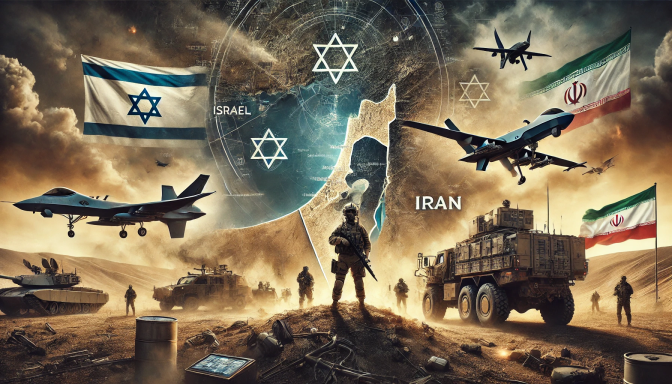
On February 28, 2026, the United States and Israel launched one of the most consequential military operations in modern Middle East history — a joint strike campaign against the Islamic Republic of Iran dubbed Operation Epic Fury. Within the first 12 hours, nearly 900 strikes were executed, killing Supreme Leader Ayatollah Ali Khamenei, dozens of senior military and government officials, and targeting nuclear infrastructure, air defense systems, and command nodes across 26 of Iran’s 31 provinces.
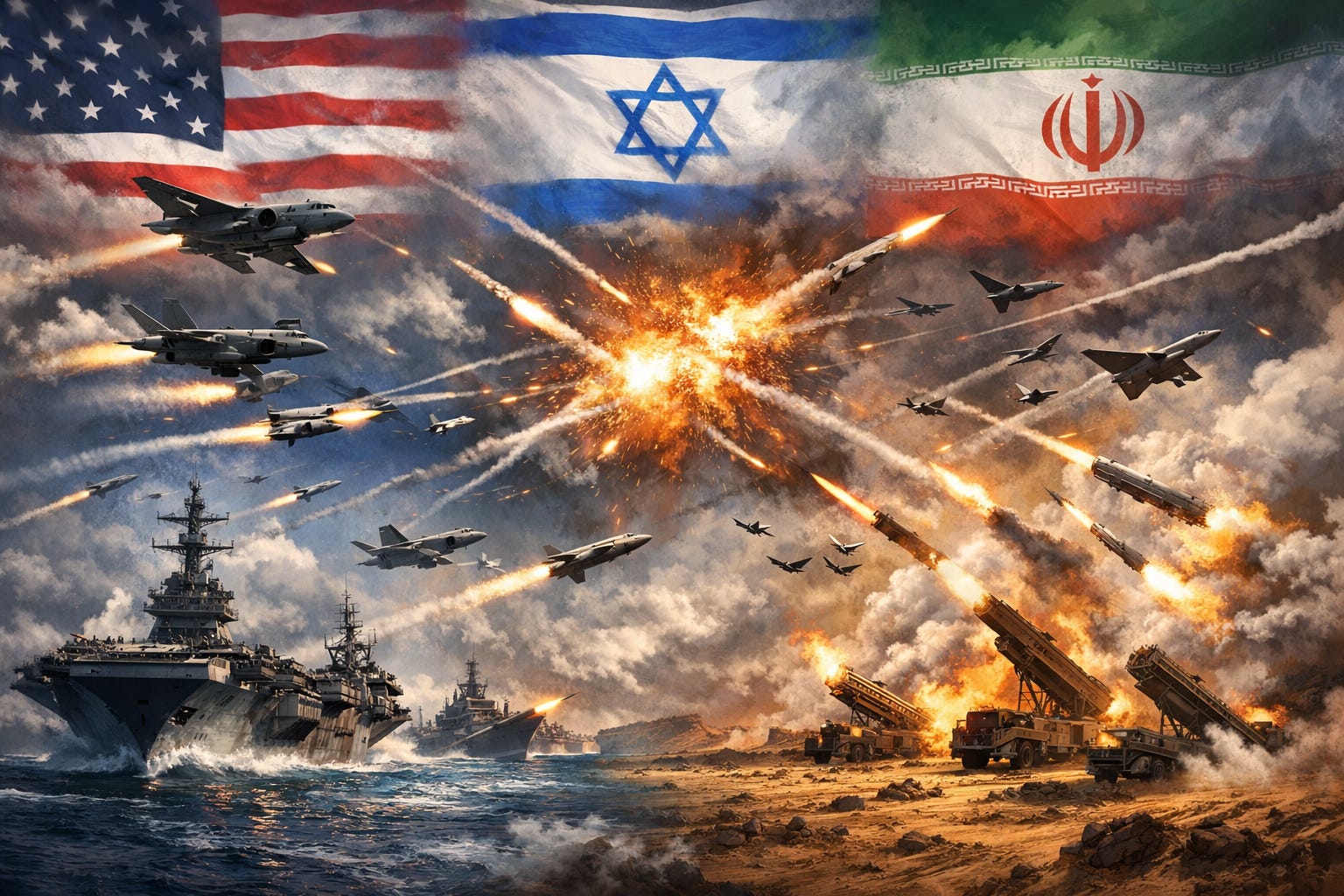
What followed was an unprecedented regional conflagration. Iran retaliated with hundreds of ballistic missiles and thousands of drones, hitting all six Gulf Cooperation Council (GCC) states — Bahrain, Kuwait, Oman, Qatar, Saudi Arabia, and the UAE — for the first time in history, as well as US military bases in Iraq, Jordan, and beyond. Iran also moved to restrict shipping through the Strait of Hormuz, triggering a global energy crisis and pushing Brent crude past $100 per barrel.
“The absence of an off-ramp has allowed the war to metastasize across the region. In 2025, Iran’s retaliation was largely contained to Israel and specific US assets. In 2026, Tehran has widened the map, launching strikes across nine countries.” — Al Jazeera, March 11, 2026
As of March 14, 2026 (Day 14), no ceasefire is in place. Unlike the 12-Day War of June 2025 — which ended via Omani mediation — the decision to “decapitate” Iran’s leadership has eliminated traditional off-ramps and locked both sides in what analysts are calling an open-ended war of attrition.
Historical Background & Root Causes
The Nuclear Program: Decades of Tension
Iran’s nuclear ambitions have been a flashpoint since the early 2000s. The 2015 Joint Comprehensive Plan of Action (JCPOA) temporarily capped enrichment, but the US under Trump unilaterally withdrew in 2018. When Trump returned to office in 2025, he reimposed maximum pressure while opening the first direct US-Iran nuclear talks since 2018. Iran was enriching uranium to 60% purity — near weapons-grade — stored at the Isfahan site, yet maintained it was for civilian use. The IAEA found no direct evidence of weapons development, but in June 2025 declared Iran in violation of non-proliferation obligations for the first time in 20 years.
Israel’s Role: Existential Stakes
Israel has long viewed a nuclear-armed Iran as an existential threat. Israeli officials argued that any diplomatic delay would allow Iran to achieve “nuclear immunity,” making military action far more costly. Israel systematically weakened Iran’s regional proxy network between 2023–2025: decimating Hamas in Gaza, decapitating Hezbollah’s leadership (killing Hassan Nasrallah in September 2024), and enabling the fall of Bashar al-Assad in Syria. By early 2026, Iran was geopolitically isolated and militarily degraded — conditions Israel and the US judged as a rare window for decisive action.
The 2025 Twelve-Day War: The Rehearsal
On June 13, 2025, Israel launched a unilateral surprise strike on Iran’s nuclear facilities, missile factories, and military leadership. Over 12 days, Iran retaliated with more than 550 ballistic missiles and 1,000+ drones. The US intercepted Iranian attacks and bombed three nuclear sites on June 22. A ceasefire brokered by Oman took effect June 24, 2025. The conflict ended Iran’s nuclear program’s aboveground infrastructure but left leadership intact — a fact that drove the 2026 escalation’s far more radical objective: regime decapitation.
Detailed Timeline: 2024–2026
Operation Epic Fury: What Happened on Feb 28
Midmorning on February 28, US and Israeli forces began what CENTCOM later confirmed involved strikes on more than 5,000 targets across Iran by March 10. The first salvo targeted: air defense radar networks, IRGC command centers, senior leadership compounds in Tehran (killing Khamenei), nuclear sites, ballistic missile production facilities, and communications infrastructure. On March 3, Israeli strikes deliberately destroyed the building where Iran’s Assembly of Experts was scheduled to meet, preventing the constitutional process for selecting a new supreme leader.
The first 100 hours of Operation Epic Fury cost the United States approximately $3.7 billion, largely unbudgeted, according to the Center for Strategic and International Studies. This is the largest US military operation in the Middle East since the 2003 invasion of Iraq.
Iran’s Retaliation & Regional Escalation
Iran’s response exceeded all prior precedents. Tehran launched what IRGC described as attacks on at least 27 US bases across the region, plus Israeli military facilities. For the first time in history, Iran struck all six GCC states simultaneously — behavior Tehran had avoided for decades to preserve economic relationships. Targets included civilian airports, luxury commercial districts (Bahrain’s Seef district), and energy infrastructure. The IRGC framed the attacks as targeting only US military installations, but civilian and civilian-adjacent infrastructure was hit across the Gulf.
Lebanon’s Hezbollah — though significantly weakened — re-entered the fight, prompting Israel to launch new military operations in Lebanon. The Lebanese government, which had been trying to disarm Hezbollah since 2024, banned Hezbollah’s military activities, creating a complex political crisis in Beirut.
Iran has partially restricted the Strait of Hormuz — through which approximately 20% of global oil supply passes — contributing to Brent crude surpassing $100/barrel, with wild daily swings. The G7 declined to jointly release strategic reserves to stabilize prices.
Humanitarian & Civilian Impact
Preliminary verified figures: at least 1,444 killed in Iran, at least 15 in Israel, 11 US soldiers killed, and 19 in Gulf states. The Iranian Health Ministry claims more than 2,500 wounded. Due to internet restrictions and limited media access inside Iran, these figures are difficult to independently verify and likely undercount actual casualties.
In Tehran — a city of 10 million — daily life continues under a choking black sky from burning oil facilities. Residents near strike zones leave apartment doors unlocked for rapid evacuation. Hundreds of thousands are displaced in Lebanon. Hundreds of thousands of travelers are stranded across the Middle East as regional airports face missile threats and closures.
International reactions are split: the UK, France, Germany, and the US have condemned Iranian counter-strikes while calling for diplomacy. Most Arab and Muslim-majority states have condemned the original US-Israel strikes. The International Commission of Jurists has characterized the Israeli strikes as violations of international law.
Global Economic Fallout
The conflict has sent shockwaves through the global economy. Brent crude has surpassed $100/barrel with ongoing volatility. The IMF’s chief Kristalina Georgieva warned that every 10% increase in energy prices sustained through 2026 is expected to raise global inflation by nearly half a percentage point. Saudi Arabia’s state oil company warned of “drastic” global effects if war continues, while indicating it can reroute some exports through the Red Sea.
The cascading effects are already visible: Bangladesh has closed universities early for summer; Pakistan and the Philippines declared four-day work weeks. Global shipping costs have spiked. Airlines operating in the region face massive disruptions. Investors are fleeing regional assets, and currencies in import-dependent developing nations are under acute pressure.
Diplomacy, Failed Talks & the Path Forward
The tragic backdrop to this war is how close a deal came. Iranian Foreign Minister Abbas Araghchi stated on February 25 that a “historic agreement” to avert conflict was “within reach.” A third round of indirect talks took place in Geneva on February 26 — but the sides remained far apart on Iran’s demand to preserve civilian enrichment rights. Two days later, bombs fell.
Unlike the 2025 Twelve-Day War, which ended in a US-brokered ceasefire, the assassination of Khamenei has created a leadership vacuum that makes any negotiating partner uncertain. Iran’s Assembly of Experts — constitutionally tasked with selecting a new supreme leader — cannot convene after Israeli strikes destroyed its scheduled meeting venue. This has created an unprecedented governance vacuum in Tehran that complicates any path to diplomatic resolution.
The UK has offered bases (Diego Garcia and RAF Fairford) for limited “defensive” US operations to destroy Iranian missiles at source. UK PM Keir Starmer stated he does “not believe in regime change from the skies.” As of Day 14, no neutral party has successfully proposed a credible ceasefire framework.